
ext_14267 (![[identity profile]](https://www.dreamwidth.org/img/silk/identity/openid.png) laughingacademy.livejournal.com) wrote in
laughingacademy.livejournal.com) wrote in ![[community profile]](https://www.dreamwidth.org/img/silk/identity/community.png) crack_van2004-10-20 06:41 am
crack_van2004-10-20 06:41 am
laughingacademy.livejournal.com) wrote in crack_van2004-10-20 06:41 am


Entry tags:
Sherlock Holmes: An Overview
Or, the Thing That Ate My Brain. I apologize for posting this piecemeal, but I had no idea it would turn out to be such a monster.
Introduction
The Characters
Our Heroes • Family and Friends • Worthy Adversaries
The Stories
A Study in Scarlet • The Sign of Four
The Adventures of Sherlock Holmes • The Memoirs…
THE GREAT HIATUS
The Hound of the Baskervilles
The Return… • The Valley of Fear • His Last Bow • The Case-Book…
Notable Adaptations
The Rathbone–Bruce Films
The Granada Television Series
The Twenty-first Century
Pairings
The Fandom On-line
Acknowledgments
In his preface to The Case-Book of Sherlock Holmes, Arthur Conan Doyle wrote:
Little did Sir Arthur know that he had created the literary equivalent of a virus. The tales have never gone out of print, and they have inspired works in every conceivable medium. These include near-countless novels and short stories, at least three plays, radio shows, comic books, a Broadway musical, a ballet, various television series (both live-action and animated) and films (ditto).
Additionally, Sherlock Holmes takes pride of place as the ur-fandom. So far as I know, Sherlockians, or Holmesians, were the first to refer to their source material as “the Canon” (an anagrammatic play on “Conan” and a synonym for the other collective name for the stories, “the Sacred Writings”). Since the oldest formal fan society, the Baker Street Irregulars of New York, held its first meeting in 1934 such organizations have spring up all over the world, and their members…you think Trekkies are fanatical? You think Tolkienites like footnotes? Ha! Pikers!
Sherlockians have a particularly rich vein to work since Conan Doyle wrote the Holmes stories with little regard for continuity or, at times, factual accuracy. Thus, readers have happily pondered such puzzles as the chronological order of the stories (I believe there are half a dozen competing timelines), the exact location of Watson’s war injury, and whether there exists a breed of snake that drinks milk and can be trained to obey a whistle. Furthermore, many of the stories contain references to other cases that were never published, a situation that hundreds of writers have worked to rectify.
Perhaps the ultimate proof of Holmes’s ubiquity is the confusion over whether he is fictional or historical. This is partly due to what Sherlockians call “the Game”: the tradition of pseudo-scholarly articles based on the premise that Holmes et al were real people. Many writers have further blurred the line between fact and fiction by including historical characters like Sigmund Freud, Oscar Wilde, and Jack the Ripper in new Sherlock Holmes stories. This fantastic conspiracy is now widespread: for example, the Royal Society of Chemistry awarded Holmes an honorary fellowship in October 2002. (For a good description of the phenomenon, check out this entry at the Straight Dope site.)
But who are Sherlock Holmes and his associates, and why do people still care?
Warning: The following biographies contain spoilers for various stories...but since the last book was published in 1927 I’m not sweating it that much.
Our Heroes
Sherlock Holmes
 Holmes is a mass of contradictions: a “thinking machine” (SIGN) with “art in the blood” (GREE) and a dash of the knight-errant. A “connoisseur of crime” (SIGN), Holmes’s interest in a case is determined more by the challenge it presents than the magnitude of the offense or the rank of the people involved.
Holmes is over six feet tall, thin, dark-haired, aquiline in profile, and has gray eyes; he can alter or conceal all of these distinguishing features with uncanny skill when in disguise. While on a case he frequently skimps on food and sleep. Between jobs he’s prey to boredom, restlessness, and depression, which for a while led to thrice-daily injections of cocaine and, less frequently, morphine, a habit he eventually gave up with Watson’s help. Working or not, he smokes like a chimney. In spite of all this he is surprisingly strong (in “The Adventure of the Speckled Band” he straightens a bent poker with his bare hands) and adept in boxing, fencing, and a Japanese martial art called baritsu.* However, his favored pastimes are cerebral. He is a polymath who initially appears to be interested only in fields that are applicable to his profession, namely chemistry, biology, and criminology. This impression is contradicted by later stories in which he displays an interest in history, literature (judging from his many apt quotations), philology, music (he plays the violin—a Stradivarius he found in a pawnshop—and attends concerts), and art.
While Holmes is not a sociable man—he’s arrogant, at times breathtakingly tactless, and often unnerves people with his deductions—he can be charming, and he has a knack for dealing with distraught clients and balky witnesses. He demonstrates an unusual understanding of children, whom he observes for insight into their parents’ characters and sometimes employs as assistants. He admires brave and clever women, and is protective of damsels in distress, but is, in his own words, “not a whole-souled admirer of womankind” (VALL); he even tells Watson, “Women are never to be entirely trusted—not the best of them” (SIGN). A wry, whimsical sense of humor enables him to admit his errors and laugh at himself. He has acquaintances in all walks of life but appears to have no family, aside from his elder brother Mycroft, and few close friends, with the notable exception of his fellow-lodger and chronicler, Watson.
* Interesting Trivia: When I first wrote this recap, I believed that baritsu was an invention of Conan Doyle’s. I have since learned that he may have been referring to Bartitsu, a school of self-defense, based on jujitsu, which was taught in London between 1899 and 1902.
John H. Watson, M.D.
 An ex–military surgeon whose army career was ended by a bullet and a bout of enteric fever, Watson is leading a “comfortless, meaningless existence” (STUD) when he agrees to share a set of rooms with Sherlock Holmes.
Watson, a former rugby player, is “a middle-sized, strongly built” man with a mustache, square jaw, and thick neck (CHAS), though he is “thin as a lath and brown as a nut” when we first see him. Shortly after their introduction he tells Holmes, “my nerves are shaken, and I get up at all sorts of ungodly hours, and I am extremely lazy. I have another set of vices when I’m well.” Watson may be a slugabed, though he is “not a very sound sleeper” (HOUN), and his claim of “an experience of women which extends over many nations and three separate continents” (SIGN) may hint at the nature of those other, unspecified vices; however, most of this slighting assessment is contradicted by his own accounts. Though not as observant or quick-witted as Holmes, he can present facts in a lucid and entertaining manner, and after some initial skepticism he becomes adept at following Holmes’s deductions. Perpetually shocked by humanity’s capacity for evil yet not disheartened by it, he is sensible, compassionate, and unshakably loyal.
A peripatetic life (he earned his doctorate at the University of Edinburgh and worked at London’s St. Bartholomew’s Hospital before his military service in Afghanistan) brought Watson many acquaintances but few close friends aside from Holmes. He has “neither kith nor kin in England” (STUD), and his only mention of any relatives are when he confirms Holmes’s deductions about a father and an elder brother, both deceased, shortly before the first appearance of his only Canonically identified spouse, Mary Morstan. (An unnamed wife appears in stories both pre- and postdating the doctor’s marriage to Mary, which implies that he wed at least one other woman.) His duties as a husband and physician cause Watson to drift apart from Holmes, but he occasionally rejoins his friend for a case. When Holmes reappears after the Great Hiatus, Watson sells his practice (interestingly, the buyer is a distant relation of Holmes who pays with money supplied by the detective) and returns to 221B.
Family and Friends
Mary Morstan (Mrs. John H. Watson)
 (Note: All quotations are from SIGN unless attributed otherwise.)
Mary Morstan is the daughter of Captain Arthur Morstan, an Indian Army officer. After her mother died Mary was sent to Edinburgh, where she lived in a boarding establishment. She and Watson met when she sought Holmes’s aid in The Sign of Four, and were engaged by the story’s end. At the time, Miss Morstan was working as a governess.
Watson describes her as “a blonde young lady, small, dainty, well gloved, and dressed in the most perfect taste…Her face had neither regularity of feature nor beauty of complexion, but her expression was sweet and amiable, and her large blue eyes were singularly spiritual and sympathetic…. I have never looked upon a face which gave a clearer promise of a refined and sensitive nature.” Holmes was also taken with her, for different reasons: “I think she is one of the most charming young ladies I ever met and might have been most useful in such work as we have been doing.”
Mary appears to have died during the Great Hiatus, as Watson states in “The Adventure of the Empty House” that Holmes “had learned of my own sad bereavement.”
Mycroft Holmes
 (Note: All quotations are from GREE unless attributed otherwise.)
According to Sherlock Holmes, his brother, Mycroft, is his superior in observation and deduction but “will not even go out of his way to verify his own solutions, and would rather be considered wrong than take the trouble to prove himself right.” He rarely goes anywhere but his Whitehall office, the Diogenes Club (of which he was a founding member), and his Pall Mall lodgings, hence Sherlock’s surprise whenever Mycroft appears at 221B.
Mycroft is seven years older than Sherlock, and corpulent, but there is nonetheless a strong fraternal resemblance. As Watson puts it, “his face, though massive, had preserved something of the sharpness of expression which was so remarkable in that of his brother. His eyes, which were of a peculiarly light, watery gray, seemed to always retain that far-away, introspective look which I had only observed in Sherlock’s when he was exerting his full powers.” Their kinship is underscored by mutual respect and trust: Mycroft recommends Sherlock as the best man for the case in “The Adventure of the Greek Interpreter” and “The Adventure of the Bruce-Partington Plans,” while Sherlock relies on Mycroft’s aid to evade Moriarty’s minions during his flight from London and subsequent travels.
Holmes at first tells Watson that his brother “audits the books in some of the government departments,” but later reveals that Mycroft’s ability to recall and correlate data enables him to act as a clearinghouse for government policy, making him “the most indispensable man in the country” (BRUC). Fanonically, the latter statement is often interpreted to mean that Mycroft is the head of an espionage network.
Mrs. Hudson
 Mrs. Hudson (her first name is unknown, but she is often called “Martha” on the assumption that she is the housekeeper who infiltrated the German spy Von Bork’s household under Holmes’s direction in “His Last Bow”) is the landlady of 221 Baker Street. Ordinarily, she performs housekeeping duties, provides meals, delivers messages and correspondence, and occasionally ushers in clients. Some have interpreted Holmes’s remark that “she has as good an idea of breakfast as a Scotchwoman” (NAVA) to mean that she is a Scot, but I find the argument unconvincing and there is no other evidence on this point. Her age and appearance are unknown, but she is usually depicted as an older, maternal figure.
Mrs. Hudson is fond of Holmes despite “[h]is incredible untidiness, his addiction to music at strange hours, his occasional revolver practice within doors, his weird and often malodorous scientific experiments, and the atmosphere of violence and danger which hung around him” (DYIN). She is clearly a woman of strong nerves: the detective’s reappearance three years after his presumed demise threw her into violent hysterics, but by evening she’d recovered sufficiently to play a crucial role in setting a trap for a would-be murderer.
Inspector G. Lestrade
 Lestrade is the policeman who appears most frequently in the Canon. He is initially described as a “little sallow, rat-faced, dark-eyed fellow,” though soon afterward Watson calls him “lean and ferret-like” and later mentions “[the] assurance and jauntiness which generally marked his demeanor and dress” (STUD).
Lestrade sometimes seeks Holmes’s aid; on other occasions he happens to be the inspector assigned to a case that Holmes is pursuing; and in a few instances Holmes requests Lestrade’s assistance. At first, Lestrade’s attitude toward Holmes is a mix of condescension (since Holmes is, strictly speaking, an amateur), resentment (understandable, given Holmes’s stated opinions of members of Scotland Yard), and awe. In time he comes to admire the sleuth, and he seems genuinely glad to see Holmes in “The Adventure of the Empty House.”
The Baker Street Irregulars
 A gang of “street Arabs” whom Holmes employs as messengers and reconnaissance agents. During a case they are paid a shilling per day plus expenses, with a guinea bonus for the Irregular who achieves the object of their mission. Holmes finds them useful because they are bright, energetic, and unobtrusive. Only two members are mentioned by name: Wiggins (the leader) and Simpson. There is a fanonical belief that Holmes arranged for members of the Irregulars to be properly housed and educated.
Interesting Trivia: Also the name of the oldest Sherlockian society.
The Diogenes Club (Quotation is from GREE)
Fanonically, the Diogenes is sometimes believed to have a connection with Mycroft Holmes’s alleged espionage activities. A few Sherlockians have suggested that the club provides its members with more, ah, intimate services than Holmes enumerates.
Worthy Adversaries
Irene Adler (Mrs. Godfrey Norton)
 (Note: All quotations are from SCAN unless attributed otherwise.)
(Or as I call her, the Face that Launched an Unsinkable ’Ship.) Irene Adler is a New Jersey–born operatic contralto and “well-known adventuress” with a knack for cross-dressing. Holmes calls her “the woman,” and presumably she is the lady whom the detective is referring to in “The Five Orange Pips” when he says, “I have been beaten four times—three times by men, and once by a woman.”
Her appearance is described only in generalities. Holmes reports that the workingmen in Adler’s neighborhood think her “the daintiest thing under a bonnet on this planet,” and says she has “a face a man might die for.” Watson describes her as a “beautiful creature” with a “superb figure” who shows “grace and kindliness” while ministering to a disguised Holmes.
Professor James Moriarty
 (Note: All quotations are from FINA unless attributed otherwise.)
“The Napoleon of crime” is the most sinister figure in the Canon. Holmes condemns and lauds him as “the greatest schemer of all time, the organizer of every deviltry, the controlling brain of the underworld…so admirable in his management and self-effacement [that he is] aloof…from general suspicion” (VALL).
Watson sees Moriarty only fleetingly and at a distance, but Holmes describes the Professor in detail: “He is extremely tall and thin, his forehead domes out in a white curve, and his [gray] eyes are deeply sunken in his head. He is clean-shaven, pale, and ascetic-looking…. His shoulders are rounded from much study, and his face protrudes forward and is forever slowly oscillating from side to side in a curiously reptilian fashion.” He is “of good birth” and has two brothers: one (also, oddly, named James) a colonel, whose letters defending the Professor’s posthumous reputation spur Watson to write “The Final Problem”; the other, a station-master in the West of England (VALL).
Interesting Trivia: T. S. Eliot paid homage to Moriarty in Old Possum’s Book of Practical Cats with his “mystery cat” Macavity, who shares a sobriquet and several distinguishing features with Conan Doyle’s creation.
Colonel Sebastian Moran
 (Note: All quotations are from EMPT.)
An ex-solider, celebrated big-game hunter, and confederate of Professor Moriarty, Moran is “the second most dangerous man in London.” He was one of the few people who knew that Holmes had not died at the Reichenbach Falls, having tried and failed to kill the detective after witnessing his triumph over Moriarty from a distance.
Like Moriarty, Moran is of good family. The son of Sir Augustus Moran (Companion of the Bath and one-time British Minister to Persia), and a graduate of Eton and Oxford, he did well in the army but eventually, “[w]ithout any open scandal…made India too hot to hold him. He retired, came to London, and again acquired an evil name.” He was recruited by Moriarty to act as his chief of staff and occasional assassin. Following Moriarty’s death, Moran continues his criminal ways, killing the Honorable Ronald Adair to keep the young man from exposing him as a card sharp. Moran is captured during a second attempt on Holmes’s life following the sleuth’s return to London. At that time he is “an elderly man, with a thin, projecting nose, a high, bald forehead, and a huge grizzled moustache,” whose “cruel blue eyes” have “drooping, cynical lids” set in a face “gaunt and swarthy, scored with deep, savage lines…tremendously virile and yet sinister…[w]ith the brow of a philosopher above and the jaw of a sensualist below.”
“The Canon” consists of fifty-six short stories (which originally appeared in the Strand magazine before being collected into five volumes) and four novels. Instead of recapping every tale I’ll touch on some of the high points, while attempting to avoid revealing the solutions to the mysteries.
A Study in Scarlet (SIGN)
In Part One, Watson, after a précis of his army career, hospitalization, and post-discharge life in London, recounts his introduction to Holmes—“You have been in Afghanistan, I perceive.” “How on earth did you know that?”—and their first days together at 221B Baker Street. Right after he tells Watson that he is a “consulting detective,” Holmes receives a request to investigate the death of Enoch J. Drebber and invites Watson to come watch him work. The next day, Drebber’s traveling companion, Joseph Stangerson, is found dead in their hotel room. After some setbacks Holmes fingers the culprit, who is taken into police custody following a knockdown drag-out fight in Holmes’s sitting room, the first of what must have been an unending series of housekeeping crises for Mrs. Hudson. Then in Part Two, the Mother of All Flashbacks, we’re given the killer’s story, which involves a Mormon secret society and a doomed romance.
The Sign of Four [a.k.a. The Sign of the Four] (SIGN)
After a leisurely opening in which Watson lectures Holmes on his cocaine use, the action begins with the arrival of Mary Morstan. She asks Holmes and Watson to accompany her to a meeting with an anonymous correspondent who has sent six pearls and a pledge to redress an unspecified wrong done to her. The resulting case stretches from an aesthetic hypochondriac’s oriental suite in South London, to a locked room murder in Norwood, to a steamboat chase down the Thames, and encompasses the disappearance of Mary Morstan’s father, blood oaths, a hidden treasure, a peg-legged man, and a pygmy cannibal. Meanwhile, Watson and Mary fall in love, and by the story’s end they are betrothed.
Interesting Trivia: Conan Doyle met Oscar Wilde at a luncheon hosted by Lippincott’s magazine, the periodical which commissioned both The Sign of Four and Wilde’s The Picture of Dorian Gray.
The Adventures of Sherlock Holmes
The Memoirs…
THE GREAT HIATUS
The three-year period between “The Final Problem” and “The Adventure of the Empty House.” In the latter story Holmes gives Watson a synopsis of his movements during this time:
The Hound of the Baskervilles (HOUN)
Are the deaths around a Devonshire estate the work of a spectral hound fulfilling an ancient curse, or is there a more material agent at work? The cast includes a country doctor who wants to finger Holmes’s parietal fissure, a secretive butler married to a doleful housekeeper, a butterfly-chasing naturalist, a litigious amateur astronomer and his disowned divorcée daughter, and a murderer recently escaped from the local prison. The best known and most frequently filmed story of the Canon, even though Holmes spends much of the book offstage while Watson accompanies the Baskerville heir to the wilds of Dartmoor, this novel was written after “The Final Problem” but set before it, so officially Holmes was still dead.
The Return…
The Valley of Fear (VALL)
The fourth and final Sherlock Holmes novel bears a striking resemblance to the first. Like A Study in Scarlet, the book is divided into two parts. The first follows Holmes as he investigates a death—this time of a man found in moated Birlstone Manor House, his face destroyed by a double blast from a sawed-off shotgun. The second informs the reader of earlier events in Vermissa Valley, Pennsylvania, U.S.A., where jealousy and conspiracy spawn a decades-long vendetta. Finally, there is an epilogue in which we learn the ultimate fates of the principals in the case. However, there is one great difference between this story and its predecessor: the involvement of Professor Moriarty. It is an informant in Moriarty’s network who sends Holmes a ciphered message warning of the threat at Birlstone, and it is clearly the Professor who anonymously penned the mocking note which reads, “Dear me, Mr. Holmes! Dear me!” that the detective receives at the story’s conclusion.
Interesting Trivia: The American portions of The Valley of Fear were inspired by Allan J. Pinkerton’s The Molly Maguires and the Detectives. Pinkerton’s book is a fictionalized account of the campaign that members of his private detective agency conducted against a secret society of Pennsylvania coal miners, who were either a ruthless gang of thugs or exploited men trying to protect themselves from the minions of rapacious industrialists, depending on which historians you believe.
His Last Bow
The Case-Book…
According to the Guinness World Records, “The character most frequently recurring on the screen is Sherlock Holmes…portrayed by some 75 actors in over 211 movies since 1900.” I will be discussing only a few of these performances. Those interested in learning more should visit the pages on Holmes in film and television at the Sherlock Holmes Society of London’s official Web site. There are also various books on the subject; I recommend David Stuart Davies’s Holmes of the Movies and Starring Sherlock Holmes, and The Films of Sherlock Holmes by Chris Steinbrunner and Norman Michaels.
The Rathbone–Bruce Films

In March 1939, Twentieth Century-Fox released The Hound of the Baskervilles, starring Basil Rathbone, a Shakespearean-trained actor best known for playing aristocratic villains, as Sherlock Holmes (though he’s billed second, after Richard Greene as Henry Baskerville) and Nigel Bruce as Dr. Watson (billed fourth). The studio made a point of announcing that this was the first Holmes film to present the sleuth in his proper Victorian milieu (unlike earlier movies, which had shown the detective using telephones and automobiles). The set for 221B is far too bare and grandiose, but the London streets are well realized, and the moor, an enormous soundstage swathed in picturesque billows of artificial fog, is spectacular. The script is largely faithful to Conan Doyle’s story, aside from streamlining in some places and expansion in others. The direction is competent, though occasionally the pace lags, and while no attempt is made to give the hound a supernatural appearance its climactic pursuit and attack are genuinely nerve-wracking. I must comment on the final scene, which is jarring: after a grateful character says, “God bless you, Mr. Holmes,” the detective thanks him and announces he is going to bed, only to call from the room’s threshold, “Oh, Watson, the needle.” Excuse me while pick my jaw off the floor.
Encouraged by the enthusiastic response to The Hound, the studio pursued hopes of a lucrative series by filming The Adventures of Sherlock Holmes later that year. The opening credits claim it is based on William Gillette’s play Sherlock Holmes, which is a thumping lie: aside from the characters of Holmes, Watson, Billy the page boy, Moriarty, and Moriarty’s henchman Bassick, the movie takes nothing from the stage melodrama. This second film has better direction but a weaker script: two key characters’ motives are left unclear, and the plot—in which Moriarty uses a bizarre murder to distract Holmes from his attempt to steal the crown jewels from the Tower of London—is full of holes. (Among other absurdities, the heroine attends a garden party in a frilly, light-colored frock two days after her brother’s death, when etiquette would have required her to withdraw from society and wear full mourning for three months. However, her actions give Holmes the opportunity to disguise himself as a Cockney song-and-dance man, a moment not to be missed.) The Conan Doyle estate was dissatisfied with The Adventures and asked that all future productions be adaptations from the Canon. When Twentieth Century-Fox balked at this requirement, they lost the chance to make more Holmes films.
Three years passed, during which Rathbone and Bruce started playing Holmes and Watson in radio dramas, before a new series of films began under the aegis of Universal Pictures. From 1942 to 1946 the studio released twelve movies: Sherlock Holmes and the Voice of Terror (September ’42), SH and the Secret Weapon (January ’43), SH in Washington (April ’43), SH Faces Death (September ’43), The Spider Woman (January ’44), The Scarlet Claw (June ’44), The Pearl of Death (August ’44), The House of Fear (March ’45), The Woman in Green (June ’45), Pursuit to Algiers (October ’45), Terror by Night (February ’46), and Dressed to Kill (May ’46). Several of the films are credited as adaptations of specific tales (which in practice means only the use of a distinctive character or a plot device from the Canon), while others are merely based on “a story” or “characters created” by Sir Arthur Conan Doyle. Unlike the Twentieth Century-Fox films, they are set in the 1940s (though oddly enough, the new 221B set is far more convincing than its predecessor). The first three are spy thrillers that pit Holmes and Watson against agents of the Third Reich, while the remainder are murder mysteries. The quality of the scripts varies, but director Roy William Neill—who helmed all but the first of the Universal movies—does an excellent job, and the acting is consistently good.
This brings us to the question of Rathbone’s and Bruce’s performances. Between the films and the radio shows, it’s no wonder that they are the actors most closely associated with Holmes and Watson to this day. This was both good and bad for the fandom: good, because they kept the characters in the public eye; bad, because theirs is a distorted version of the Canonical relationship between the detective and his chronicler. Now, Basil Rathbone is wonderful: with his height, lean figure, high forehead, and strong profile, he bears a striking resemblance to the Paget illustrations. He delivers his dialogue briskly, has a lot of fun with the disguises, and is convincingly ruminative, arrogant, sardonic, and masterful. One reviewer described his performance as “making the character credible rather than eccentric,” which strikes me as a fair verdict. His co-star, Nigel Bruce, is convincing and endearing as Watson; the problem is that the writers made him the comic relief, so Bruce is often playing an idiot. This is most observable in the Universal series, but it has its roots in the Twentieth Century-Fox films. In his commentary for MPI’s DVD release of The Hound, David Stuart Davies, editor of Sherlock Magazine, makes an interesting observation: Watson is competent and sensible on his own, but around Holmes he bumbles and blusters as though overawed. I think their dynamic is best illustrated by a scene from The Adventures, in which the detective tells Watson, “I’m afraid you’re an incorrigible bungler,” and the downcast doctor murmurs, “Afraid I am.” Holmes then pats his friend on the shoulder, and Watson immediately perks up and smiles. Overall the impression is of a man who is loyal and brave, but rather dim.
Following Dressed to Kill, Rathbone announced that he would no longer play Holmes in films or on the radio. He’d begun to find the detective unpleasant, especially in his condescending treatment of Watson, and feared he’d become, as he phrased it in his autobiography In and Out of Character, “more completely ‘typed’ than any other classic actor has been or ever will be again.” Despite his resolution he did don the deerstalker a couple more times, most notably in an unsuccessful stage play written by his wife, Ouida, and the role haunted him until his death in 1967.
The Granada Television Series

Of all the actors who have played Sherlock Holmes in the past sixty years, only one is a serious threat to Basil Rathbone’s supremacy: Jeremy Brett. He starred in six series—two titled The Adventures (April–June 1984 and August–September 1985, 13 episodes total), two titled The Return (July–August 1986 and April 1988, 11 episodes) The Casebook (February–March 1991, 6 episodes), and The Memoirs (March–April 1994, 6 episodes)—and five feature-length episodes—The Sign of Four (December 1987), The Hound of the Baskervilles (August 1988), The Master Blackmailer (January 1992), The Last Vampyre (January 1993) and The Eligible Bachelor (February 1993)—produced by British company Granada Television.
Born Peter Jeremy William Huggins (he picked his alias off a suit label after his father asked him not to pursue a theatrical career under the family name), Brett had a knack for upper-class figures with romantic and/or sinister tendencies. His previous roles included Dorian Gray, Dracula (in a stage production designed by Edward Gorey), and Freddie Eynsford-Hill in the movie musical My Fair Lady. In interviews he sometimes claimed that he felt horribly miscast as Holmes, but this seems to have made him all the more determined to delve into the detective’s psyche. He augmented close readings of Conan Doyle by imagining a childhood and adolescence for Holmes that included many autobiographical elements. The result is a hugely idiosyncratic performance that nonetheless hews to the Canon. Brett’s eccentric investigator is arguably both the strangest and most human version of the character yet seen. This Holmes is brilliant, energetic, charismatic, and funny; he’s also overbearing, untidy, and frequently bad tempered. He literally lunges at clues, and heaven help the recalcitrant witness or resentful Scotland Yarder who stands in his way. When disguised he’s often unrecognizable until he reveals himself. Above all, he’s mercurial: whether he’s questioning a client, crawling over a carpet, or swaying with closed eyes at a recital, it’s nearly impossible to look away, in large part because you can never be sure what he’s going to do next. The fact that in The Adventures, The Return, and The Sign of Four he’s very easy on the eyes doesn’t hurt. And oh, don’t get me started on the voice.


As good as he is, Brett’s performance would not have been so effective if he hadn’t had a great Watson to play against. Fortunately, he got lucky twice. In The Adventures the character is portrayed by David Burke, who depicts Watson as bright, bluff, and blessed with a backbone. When Burke left the role to spend more time with his family, he suggested Edward Hardwicke as his successor. The proposal proved a sound one, and Hardwicke played the doctor in all the other Granada adaptations. His Watson is quieter and mellower than Burke’s, but he’s just as wry, sensible, and sympathetic. Brett has a wonderful rapport with both actors, and throughout the Granada series Holmes’s affection for his friend and amanuensis is both obvious and inarguable—Watson possesses an appetite for adventure, moral sense, compassion, and above all, faithfulness, that make him the ideal partner and confidante for the detective.
Unfortunately, the quality and high level of Canonical fidelity that characterize the first four series and The Sign of Four could not be sustained through the later productions. This was partly due to changes in the executive staff at Granada: as new people replaced the series’ creators, the determination to be absolutely faithful to Conan Doyle’s stories waned. Another issue was the dwindling supply of source material—the best stories had already been done, and the remainder required more rewriting to be interesting television. This was especially true of The Last Vampyre and The Eligible Bachelor, which differ so greatly from the stories which inspired them (“The Sussex Vampire” and “The Noble Bachelor,” respectively) that they’re nearly unrecognizable. But the biggest problem was the string of crises that beset Jeremy Brett. First, his wife Joan Wilson, an American television executive, died of cancer in the summer of 1985. Later, during the filming of The Return, Brett was hospitalized for ten weeks after suffering a breakdown. During his recovery the actor, long known for eccentric and flamboyant behavior, was diagnosed as manic-depressive and prescribed lithium, which improved his psychological state but had unfortunate side effects: bloating from water retention, decreased energy, difficulty concentrating, and worst of all, the progressive deterioration of his heart. By the time he made The Memoirs, Brett’s health was so poor that he collapsed on set. He died on September 12, 1995, the year after his final performances as Sherlock Holmes were broadcast.
The Twenty-first Century
A clear successor to Brett has yet to emerge, but there have been attempts. As of 2004, Matt Frewer (Max Headroom) has starred in four Holmes TV movies, to mixed reviews. In 2002 Richard Roxburgh (Moulin Rouge!, The League of Extraordinary Gentlemen, Van Helsing) played the detective in a BBC production of The Hound of the Baskervilles, in which his Holmes had an unusually contentious relationship with Ian Hart’s Watson. Hart will reprise his role opposite another new Holmes, Rupert Everett, in a project titled The Return of Sherlock Holmes. They’ll be facing competition from longtime Sherlockian Stephen Fry, as Holmes, and Fry’s frequent co-star Hugh Laurie, as Watson, in a television special that may serve as a series pilot if its ratings are good. [Update: the Everett/Hart film, titled Sherlock Holmes and the Case of the Silk Stockings, aired in 2004 and was largely regarded as a disappointment despite Everett’s and Hart’s excellent performances. Sadly, nothing has come of the Fry/Laurie project, though as the protagonist of House M.D. Hugh Laurie is quite Sherlockian.]
December 2009 saw the release of Sherlock Holmes, directed by Guy Ritchie and starring Robert Downey, Jr., as Holmes, Jude Law as Watson, and Rachel McAdams as Irene Adler. Downey’s Holmes is a raffish, Bohemian genius whose fists are as fast as his mind, while Law portrays the most competent and complicated Watson yet. The film, which pits our heroes against a murderous occultist, both follows and disregards Canon—for example, Watson’s fiancée is clearly identified as Mary Morstan, yet the events of The Sign of Four have not occurred, for she is a stranger to Holmes with living relations. Overall, this adaptation is more respectful towards the source material than not, and probably won’t offend any fan who doesn’t object to martial arts, magical rituals, and explosions on principle.
Holmes/Irene Adler
There is widespread belief in a Holmes/Adler romance—often claimed to have resulted in a son—despite seemingly insurmountable obstacles. First, Watson specifies that Holmes felt “no emotion akin to love” for the lady. Second, Holmes witnesses Adler’s marriage to Godfrey Norton, a barrister. Finally, Watson’s description of Adler as being “of dubious and questionable memory” implies that she died sometime before he penned “A Scandal in Bohemia.” Most Holmes/Adler ’shippers blithely disregard the first statement and declare the third an error, while the inconvenient Norton is dismissed as a corpse or a cad when he’s acknowledged at all. (An exception is Carole Nelson Douglas’s Irene Adler Adventuress series, in which a crime-solving Adler’s happy marriage to Norton still allows gobs of UST with Holmes.)
Watson/Mary Morstan
Aside from their courtship in The Sign of Four we aren’t told much about Watson’s marriage to Mary. She is presented as supportive of her husband’s continued participation in Holmes’s cases, and likely felt some fondness and gratitude toward the detective for introducing her to Watson, not to mention solving the mystery of her father’s disappearance. On the other hand, some Sherlockians have suggested that she saw Holmes as a rival for her spouse’s attention. However, as Watson reports that “after my marriage…these occasions grew more and more seldom, until I find that in the year 1890 there were only three cases of which I retain any record” (FINA), it would appear that he made his domestic and professional obligations his highest priorities.
Mary’s presumed death during the Great Hiatus is sometimes ascribed to complications arising from a miscarriage, because God forbid the fans miss an opportunity to pile on the angst.
Holmes/Various OFCs
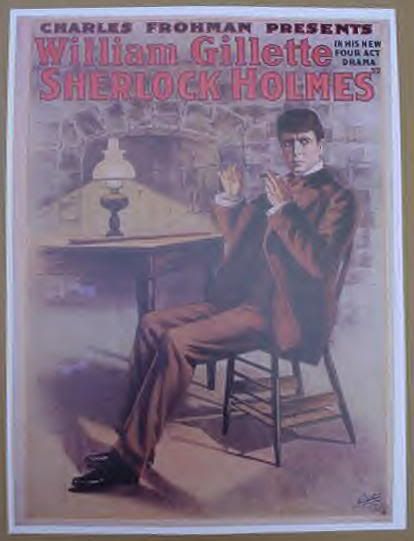
Although Holmes’s usual love interest is the Woman, he has been linked with others. The earliest example was in William Gillette’s stage melodrama Sherlock Holmes, which ended with the detective engaged to the insipid ingenue, Alice Faulkner. However, it occurs most frequently in films: during Billy Wilder’s 1971 film The Private Life of Sherlock Holmes, the sleuth softens toward his client; the end of The Seven-Per-Cent Solution (1976) implies a dalliance with the distressed damsel; and the wildly AU Young Sherlock Holmes (1985, script by Chris Columbus, directed by Barry Levinson, with Stephen Spielberg as executive producer; no, really) claims that Holmes chose to remain true to the memory of a mentor’s daughter. Most recently, Laurie R. King’s popular Sherlock Holmes/Mary Russell books have paired the detective with a brilliant, strong-willed, Jewish-American woman who progresses from adolescent protégée to wife and full-fledged colleague.
Watson/Various OFCs
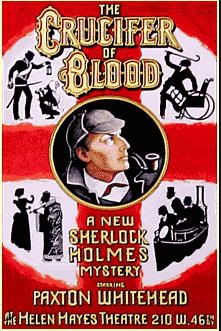
“The fair sex is your department,” Holmes says to Watson in “The Adventure of the Second Stain.” While Holmes is more frequently the object of authors’ attempts at matchmaking (probably because he’s more of a challenge), Watson gets his turn on occasion—after all, there is at least one other Mrs. Watson to be accounted for. Interestingly, one of the best-known of Watson’s uncanonical romances ends unhappily: in the play The Crucifer of Blood, which is loosely based on The Sign of Four, Watson falls for the female lead, only to discover that she is a villain.
Holmes/Watson
This is the major slash pairing for this fandom, and the fanfic comes in all flavors: first-time, longtime, happy, tragic, angry, unrequited, denied, guilty, hurt/comfort, and kinky (between Holmes’s gift for dress-up and Watson’s doctor’s-bag, imagine the possibilities!).
While the idea of a romantic or sexual relationship between the detective and his chronicler remains controversial—there’s a reason Miss Roylott named her Holmes slash archive Sacrilege!—it has been discussed in mainstream fandom. Billy Wilder raised the possibility in The Private Life of Sherlock Holmes with a scene in which Holmes fends off a Russian ballerina by claiming that Watson is his lover.* Although this was clearly a joke, many Sherlockians bristled. One member of the Sherlock Holmes Society of London stated, “We’d played around with the idea, twisting quotations and taking them out of context, but that was only for our own amusement. We’d never do it in public.”
Despite this don’t-scare-the-horses policy, I know of two commercially available books that send Holmes and Watson down Queer Street. Larry Townsend’s The Sexual Adventures of Sherlock Holmes is a collection of pornographic parodies, while My Dearest Holmes, by Rohase Piercy, is an excellent two-part pastiche which shows how Holmes and Watson’s relationship changes shortly before Watson’s marriage and immediately prior to and after the Great Hiatus.
Update: As of 2009, the topic was still a contentious one for some. After Robert Downey, Jr., speculated about Holmes’s sexual orientation and the nature of his relationship with Watson on The Late Show with David Letterman, there were news articles stating that the Conan Doyle literary estate was threatening to block any sequel to Sherlock Holmes. These reports were based on remarks attributed to Andrea Plunket, who claims to hold the remaining U.S. copyrights for the Holmes stories: “It would be drastic, but I would withdraw permission for more films to be made if they feel that is a theme they wish to bring out in the future. I am not hostile to homosexuals, but I am to anyone who is not true to the spirit of the books.” However, Ms. Plunket later denied making such a statement, and told the New York Times Arts Beat blog that she loved the film and considered it truer to Canon other cinematic adaptations. (In any case, according to Sherlockian.net, Ms. Plunket’s claims to rights in the stories have been denied by U.S. federal courts, and her attempt to trademark the name “Sherlock Holmes” was also rejected.)
*Interesting Trivia: Holmes’s predicament was inspired by an anecdote about George Bernard Shaw, in which Isadora Duncan sent him a letter declaring that they should have a child together—“With my body and your brains, what a wonder it would be.” Shaw allegedly replied, “But what if it had my body and your brains?”
Holmes/Moriarty
(Because only two people who have Done It can hate each other that much.)
It is noteworthy that Holmes’s and Moriarty’s mutual loathing does not prevent them from paying each other what appear to be sincere compliments. Holmes confesses, “My horror at [Moriarty’s] crimes was lost in my admiration at his skill,” while Moriarty tells Holmes, “It has been an intellectual treat to me to see the way in which you have grappled with this affair, and I say, unaffectedly, that it would be a grief to me to be forced to take any extreme measure.” Some Sherlockians have suggested that Holmes knew Moriarty before the professor turned criminal, or before Holmes became aware of Moriarty’s extracurricular pursuits; the professor may have tutored Holmes as a child, or encountered the future sleuth as a adolescent.
Watson/Murray
According to Watson, after he was wounded at Maiwand, “I should have fallen into the hands of the murderous Ghazis had it not been for the devotion and courage shown by Murray, my orderly, who threw me across a pack-horse, and succeeded in bringing me safely to the British lines” (STUD). Various speculations have been made concerning their relationship during Watson’s military service, and it has been suggested that they kept in touch following the doctor’s return to London.
The Canon
Camden House—all sixty of the Canonical stories, plus illustrations and other graphics, sound clips, wallpapers, and screensavers.
221B Baker Street—another site with all the stories, illustrations, and sound clips.
Livejournal Communities
Sherlock Holmes’ Journal—for fans of the Canon.
Cox & Co—a Sherlock Holmes slash community.
Fan Sites
The Sherlock Holmes Society of London
The Sherlockian.net Holmepage [sic]—An incredibly comprehensive site maintained by Sherlockian Christopher Redmond.
Sherlock Holmes International—A Sherlockian resource site which can be viewed in French, English, Dutch, Spanish, Italian, Danish, or Japanese.
Slash-Friendly Sites
Sacrilege!—a slash-oriented site with a fiction archive, articles, and a links page.
Briarbrae—a site maintained by the Old Briar Pipe, with links for those who want to research details of the Canon and Victorian England in general, many entertaining essays, and a great fic recs page. Update: The site appears to be offline.
Slash Cotillion: The Historical Slash Archive—For stories set prior to the 1960s.
I must give thanks to the habitues of cox_and_co and the Holmesslash group at Yahoo, who critiqued portions of this overview when it was a work in progress.
Many thanks also to Karen Shepherd, who kindly sent me dozens of screencaps from the Granada Television series; go check out her very handsome Tribute to Jeremy Brett.
The Game Is Afoot!
Introduction
The Characters
Our Heroes • Family and Friends • Worthy Adversaries
The Stories
A Study in Scarlet • The Sign of Four
The Adventures of Sherlock Holmes • The Memoirs…
THE GREAT HIATUS
The Hound of the Baskervilles
The Return… • The Valley of Fear • His Last Bow • The Case-Book…
Notable Adaptations
The Rathbone–Bruce Films
The Granada Television Series
The Twenty-first Century
Pairings
The Fandom On-line
Acknowledgments
Introduction
In his preface to The Case-Book of Sherlock Holmes, Arthur Conan Doyle wrote:
I fear that Mr. Sherlock Holmes may become like one of those popular tenors who, having outlived their time, are still tempted to make repeated farewell bows to their indulgent audiences. This must cease and he must go the way of all flesh, material or imaginary. One likes to think that there is some fantastic limbo for the children of imagination…. Perhaps in some humble corner of such a Valhalla, Sherlock and his Watson may for a time find a place.
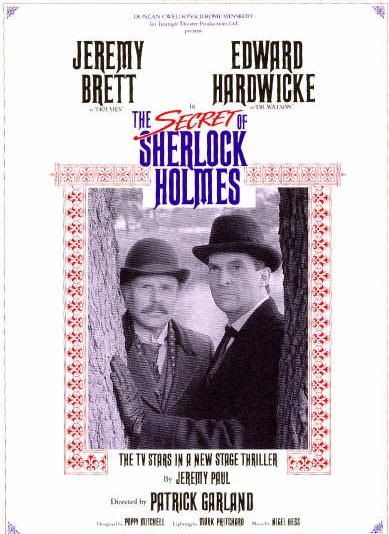
Little did Sir Arthur know that he had created the literary equivalent of a virus. The tales have never gone out of print, and they have inspired works in every conceivable medium. These include near-countless novels and short stories, at least three plays, radio shows, comic books, a Broadway musical, a ballet, various television series (both live-action and animated) and films (ditto).
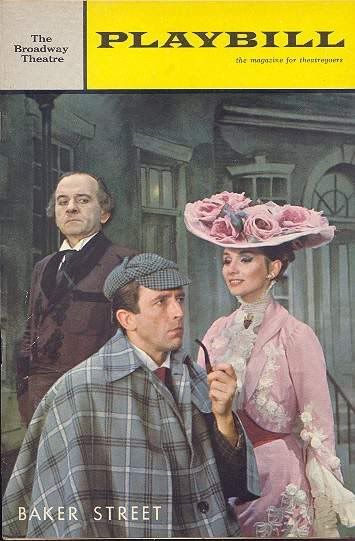
Additionally, Sherlock Holmes takes pride of place as the ur-fandom. So far as I know, Sherlockians, or Holmesians, were the first to refer to their source material as “the Canon” (an anagrammatic play on “Conan” and a synonym for the other collective name for the stories, “the Sacred Writings”). Since the oldest formal fan society, the Baker Street Irregulars of New York, held its first meeting in 1934 such organizations have spring up all over the world, and their members…you think Trekkies are fanatical? You think Tolkienites like footnotes? Ha! Pikers!
Sherlockians have a particularly rich vein to work since Conan Doyle wrote the Holmes stories with little regard for continuity or, at times, factual accuracy. Thus, readers have happily pondered such puzzles as the chronological order of the stories (I believe there are half a dozen competing timelines), the exact location of Watson’s war injury, and whether there exists a breed of snake that drinks milk and can be trained to obey a whistle. Furthermore, many of the stories contain references to other cases that were never published, a situation that hundreds of writers have worked to rectify.
Perhaps the ultimate proof of Holmes’s ubiquity is the confusion over whether he is fictional or historical. This is partly due to what Sherlockians call “the Game”: the tradition of pseudo-scholarly articles based on the premise that Holmes et al were real people. Many writers have further blurred the line between fact and fiction by including historical characters like Sigmund Freud, Oscar Wilde, and Jack the Ripper in new Sherlock Holmes stories. This fantastic conspiracy is now widespread: for example, the Royal Society of Chemistry awarded Holmes an honorary fellowship in October 2002. (For a good description of the phenomenon, check out this entry at the Straight Dope site.)
But who are Sherlock Holmes and his associates, and why do people still care?
The Characters
Warning: The following biographies contain spoilers for various stories...but since the last book was published in 1927 I’m not sweating it that much.
Our Heroes
Sherlock Holmes
Holmes is a mass of contradictions: a “thinking machine” (SIGN) with “art in the blood” (GREE) and a dash of the knight-errant. A “connoisseur of crime” (SIGN), Holmes’s interest in a case is determined more by the challenge it presents than the magnitude of the offense or the rank of the people involved. Holmes is over six feet tall, thin, dark-haired, aquiline in profile, and has gray eyes; he can alter or conceal all of these distinguishing features with uncanny skill when in disguise. While on a case he frequently skimps on food and sleep. Between jobs he’s prey to boredom, restlessness, and depression, which for a while led to thrice-daily injections of cocaine and, less frequently, morphine, a habit he eventually gave up with Watson’s help. Working or not, he smokes like a chimney. In spite of all this he is surprisingly strong (in “The Adventure of the Speckled Band” he straightens a bent poker with his bare hands) and adept in boxing, fencing, and a Japanese martial art called baritsu.* However, his favored pastimes are cerebral. He is a polymath who initially appears to be interested only in fields that are applicable to his profession, namely chemistry, biology, and criminology. This impression is contradicted by later stories in which he displays an interest in history, literature (judging from his many apt quotations), philology, music (he plays the violin—a Stradivarius he found in a pawnshop—and attends concerts), and art.
While Holmes is not a sociable man—he’s arrogant, at times breathtakingly tactless, and often unnerves people with his deductions—he can be charming, and he has a knack for dealing with distraught clients and balky witnesses. He demonstrates an unusual understanding of children, whom he observes for insight into their parents’ characters and sometimes employs as assistants. He admires brave and clever women, and is protective of damsels in distress, but is, in his own words, “not a whole-souled admirer of womankind” (VALL); he even tells Watson, “Women are never to be entirely trusted—not the best of them” (SIGN). A wry, whimsical sense of humor enables him to admit his errors and laugh at himself. He has acquaintances in all walks of life but appears to have no family, aside from his elder brother Mycroft, and few close friends, with the notable exception of his fellow-lodger and chronicler, Watson.
* Interesting Trivia: When I first wrote this recap, I believed that baritsu was an invention of Conan Doyle’s. I have since learned that he may have been referring to Bartitsu, a school of self-defense, based on jujitsu, which was taught in London between 1899 and 1902.
John H. Watson, M.D.
An ex–military surgeon whose army career was ended by a bullet and a bout of enteric fever, Watson is leading a “comfortless, meaningless existence” (STUD) when he agrees to share a set of rooms with Sherlock Holmes. Watson, a former rugby player, is “a middle-sized, strongly built” man with a mustache, square jaw, and thick neck (CHAS), though he is “thin as a lath and brown as a nut” when we first see him. Shortly after their introduction he tells Holmes, “my nerves are shaken, and I get up at all sorts of ungodly hours, and I am extremely lazy. I have another set of vices when I’m well.” Watson may be a slugabed, though he is “not a very sound sleeper” (HOUN), and his claim of “an experience of women which extends over many nations and three separate continents” (SIGN) may hint at the nature of those other, unspecified vices; however, most of this slighting assessment is contradicted by his own accounts. Though not as observant or quick-witted as Holmes, he can present facts in a lucid and entertaining manner, and after some initial skepticism he becomes adept at following Holmes’s deductions. Perpetually shocked by humanity’s capacity for evil yet not disheartened by it, he is sensible, compassionate, and unshakably loyal.
A peripatetic life (he earned his doctorate at the University of Edinburgh and worked at London’s St. Bartholomew’s Hospital before his military service in Afghanistan) brought Watson many acquaintances but few close friends aside from Holmes. He has “neither kith nor kin in England” (STUD), and his only mention of any relatives are when he confirms Holmes’s deductions about a father and an elder brother, both deceased, shortly before the first appearance of his only Canonically identified spouse, Mary Morstan. (An unnamed wife appears in stories both pre- and postdating the doctor’s marriage to Mary, which implies that he wed at least one other woman.) His duties as a husband and physician cause Watson to drift apart from Holmes, but he occasionally rejoins his friend for a case. When Holmes reappears after the Great Hiatus, Watson sells his practice (interestingly, the buyer is a distant relation of Holmes who pays with money supplied by the detective) and returns to 221B.
Family and Friends
Mary Morstan (Mrs. John H. Watson)
(Note: All quotations are from SIGN unless attributed otherwise.)Mary Morstan is the daughter of Captain Arthur Morstan, an Indian Army officer. After her mother died Mary was sent to Edinburgh, where she lived in a boarding establishment. She and Watson met when she sought Holmes’s aid in The Sign of Four, and were engaged by the story’s end. At the time, Miss Morstan was working as a governess.
Watson describes her as “a blonde young lady, small, dainty, well gloved, and dressed in the most perfect taste…Her face had neither regularity of feature nor beauty of complexion, but her expression was sweet and amiable, and her large blue eyes were singularly spiritual and sympathetic…. I have never looked upon a face which gave a clearer promise of a refined and sensitive nature.” Holmes was also taken with her, for different reasons: “I think she is one of the most charming young ladies I ever met and might have been most useful in such work as we have been doing.”
Mary appears to have died during the Great Hiatus, as Watson states in “The Adventure of the Empty House” that Holmes “had learned of my own sad bereavement.”
Mycroft Holmes
(Note: All quotations are from GREE unless attributed otherwise.)According to Sherlock Holmes, his brother, Mycroft, is his superior in observation and deduction but “will not even go out of his way to verify his own solutions, and would rather be considered wrong than take the trouble to prove himself right.” He rarely goes anywhere but his Whitehall office, the Diogenes Club (of which he was a founding member), and his Pall Mall lodgings, hence Sherlock’s surprise whenever Mycroft appears at 221B.
Mycroft is seven years older than Sherlock, and corpulent, but there is nonetheless a strong fraternal resemblance. As Watson puts it, “his face, though massive, had preserved something of the sharpness of expression which was so remarkable in that of his brother. His eyes, which were of a peculiarly light, watery gray, seemed to always retain that far-away, introspective look which I had only observed in Sherlock’s when he was exerting his full powers.” Their kinship is underscored by mutual respect and trust: Mycroft recommends Sherlock as the best man for the case in “The Adventure of the Greek Interpreter” and “The Adventure of the Bruce-Partington Plans,” while Sherlock relies on Mycroft’s aid to evade Moriarty’s minions during his flight from London and subsequent travels.
Holmes at first tells Watson that his brother “audits the books in some of the government departments,” but later reveals that Mycroft’s ability to recall and correlate data enables him to act as a clearinghouse for government policy, making him “the most indispensable man in the country” (BRUC). Fanonically, the latter statement is often interpreted to mean that Mycroft is the head of an espionage network.
Mrs. Hudson
Mrs. Hudson (her first name is unknown, but she is often called “Martha” on the assumption that she is the housekeeper who infiltrated the German spy Von Bork’s household under Holmes’s direction in “His Last Bow”) is the landlady of 221 Baker Street. Ordinarily, she performs housekeeping duties, provides meals, delivers messages and correspondence, and occasionally ushers in clients. Some have interpreted Holmes’s remark that “she has as good an idea of breakfast as a Scotchwoman” (NAVA) to mean that she is a Scot, but I find the argument unconvincing and there is no other evidence on this point. Her age and appearance are unknown, but she is usually depicted as an older, maternal figure.Mrs. Hudson is fond of Holmes despite “[h]is incredible untidiness, his addiction to music at strange hours, his occasional revolver practice within doors, his weird and often malodorous scientific experiments, and the atmosphere of violence and danger which hung around him” (DYIN). She is clearly a woman of strong nerves: the detective’s reappearance three years after his presumed demise threw her into violent hysterics, but by evening she’d recovered sufficiently to play a crucial role in setting a trap for a would-be murderer.
Inspector G. Lestrade
Lestrade is the policeman who appears most frequently in the Canon. He is initially described as a “little sallow, rat-faced, dark-eyed fellow,” though soon afterward Watson calls him “lean and ferret-like” and later mentions “[the] assurance and jauntiness which generally marked his demeanor and dress” (STUD). Lestrade sometimes seeks Holmes’s aid; on other occasions he happens to be the inspector assigned to a case that Holmes is pursuing; and in a few instances Holmes requests Lestrade’s assistance. At first, Lestrade’s attitude toward Holmes is a mix of condescension (since Holmes is, strictly speaking, an amateur), resentment (understandable, given Holmes’s stated opinions of members of Scotland Yard), and awe. In time he comes to admire the sleuth, and he seems genuinely glad to see Holmes in “The Adventure of the Empty House.”
The Baker Street Irregulars
A gang of “street Arabs” whom Holmes employs as messengers and reconnaissance agents. During a case they are paid a shilling per day plus expenses, with a guinea bonus for the Irregular who achieves the object of their mission. Holmes finds them useful because they are bright, energetic, and unobtrusive. Only two members are mentioned by name: Wiggins (the leader) and Simpson. There is a fanonical belief that Holmes arranged for members of the Irregulars to be properly housed and educated. Interesting Trivia: Also the name of the oldest Sherlockian society.
The Diogenes Club (Quotation is from GREE)
[T]he queerest club in London…There are many men in London…who, some from shyness, some from misanthropy, have no wish for the company of their fellows. Yet they are not averse to comfortable chairs and the latest periodicals. It is for the convenience of these that the Diogenes Club was started, and it now contains the most unsociable and unclubable men in town. No member is permitted to take the least notice of any other one. Save in the Stranger’s Room, no talking is, under any circumstances, allowed, and three offences, if brought to the notice of the committee, render the talker liable to expulsion.
Fanonically, the Diogenes is sometimes believed to have a connection with Mycroft Holmes’s alleged espionage activities. A few Sherlockians have suggested that the club provides its members with more, ah, intimate services than Holmes enumerates.
Worthy Adversaries
Irene Adler (Mrs. Godfrey Norton)
(Note: All quotations are from SCAN unless attributed otherwise.)(Or as I call her, the Face that Launched an Unsinkable ’Ship.) Irene Adler is a New Jersey–born operatic contralto and “well-known adventuress” with a knack for cross-dressing. Holmes calls her “the woman,” and presumably she is the lady whom the detective is referring to in “The Five Orange Pips” when he says, “I have been beaten four times—three times by men, and once by a woman.”
Her appearance is described only in generalities. Holmes reports that the workingmen in Adler’s neighborhood think her “the daintiest thing under a bonnet on this planet,” and says she has “a face a man might die for.” Watson describes her as a “beautiful creature” with a “superb figure” who shows “grace and kindliness” while ministering to a disguised Holmes.
Professor James Moriarty
(Note: All quotations are from FINA unless attributed otherwise.)“The Napoleon of crime” is the most sinister figure in the Canon. Holmes condemns and lauds him as “the greatest schemer of all time, the organizer of every deviltry, the controlling brain of the underworld…so admirable in his management and self-effacement [that he is] aloof…from general suspicion” (VALL).
[H]e won the mathematical chair at one of our smaller universities, and had, to all appearances, a most brilliant career before him. But the man had hereditary tendencies of the most diabolical kind. A criminal strain ran in his blood, which, instead of being modified, was increased and rendered infinitely more dangerous by his extraordinary mental powers. Dark rumours gathered round him…and eventually he was compelled to resign his chair and to come down to London, where he set up as an army coach [i.e., one who prepares soldiers for military exams]…. He is the organizer of half that is evil and of nearly all that is undetected in this great city…. He sits motionless, like a spider in the centre of its web, but that web has a thousand radiations, and he knows well every quiver of each of them. He does little himself. He only plans. But his agents are numerous and splendidly organized.
Watson sees Moriarty only fleetingly and at a distance, but Holmes describes the Professor in detail: “He is extremely tall and thin, his forehead domes out in a white curve, and his [gray] eyes are deeply sunken in his head. He is clean-shaven, pale, and ascetic-looking…. His shoulders are rounded from much study, and his face protrudes forward and is forever slowly oscillating from side to side in a curiously reptilian fashion.” He is “of good birth” and has two brothers: one (also, oddly, named James) a colonel, whose letters defending the Professor’s posthumous reputation spur Watson to write “The Final Problem”; the other, a station-master in the West of England (VALL).
Interesting Trivia: T. S. Eliot paid homage to Moriarty in Old Possum’s Book of Practical Cats with his “mystery cat” Macavity, who shares a sobriquet and several distinguishing features with Conan Doyle’s creation.
Colonel Sebastian Moran
(Note: All quotations are from EMPT.) An ex-solider, celebrated big-game hunter, and confederate of Professor Moriarty, Moran is “the second most dangerous man in London.” He was one of the few people who knew that Holmes had not died at the Reichenbach Falls, having tried and failed to kill the detective after witnessing his triumph over Moriarty from a distance.
Like Moriarty, Moran is of good family. The son of Sir Augustus Moran (Companion of the Bath and one-time British Minister to Persia), and a graduate of Eton and Oxford, he did well in the army but eventually, “[w]ithout any open scandal…made India too hot to hold him. He retired, came to London, and again acquired an evil name.” He was recruited by Moriarty to act as his chief of staff and occasional assassin. Following Moriarty’s death, Moran continues his criminal ways, killing the Honorable Ronald Adair to keep the young man from exposing him as a card sharp. Moran is captured during a second attempt on Holmes’s life following the sleuth’s return to London. At that time he is “an elderly man, with a thin, projecting nose, a high, bald forehead, and a huge grizzled moustache,” whose “cruel blue eyes” have “drooping, cynical lids” set in a face “gaunt and swarthy, scored with deep, savage lines…tremendously virile and yet sinister…[w]ith the brow of a philosopher above and the jaw of a sensualist below.”
The Stories
“The Canon” consists of fifty-six short stories (which originally appeared in the Strand magazine before being collected into five volumes) and four novels. Instead of recapping every tale I’ll touch on some of the high points, while attempting to avoid revealing the solutions to the mysteries.
A Study in Scarlet (SIGN)
In Part One, Watson, after a précis of his army career, hospitalization, and post-discharge life in London, recounts his introduction to Holmes—“You have been in Afghanistan, I perceive.” “How on earth did you know that?”—and their first days together at 221B Baker Street. Right after he tells Watson that he is a “consulting detective,” Holmes receives a request to investigate the death of Enoch J. Drebber and invites Watson to come watch him work. The next day, Drebber’s traveling companion, Joseph Stangerson, is found dead in their hotel room. After some setbacks Holmes fingers the culprit, who is taken into police custody following a knockdown drag-out fight in Holmes’s sitting room, the first of what must have been an unending series of housekeeping crises for Mrs. Hudson. Then in Part Two, the Mother of All Flashbacks, we’re given the killer’s story, which involves a Mormon secret society and a doomed romance.
The Sign of Four [a.k.a. The Sign of the Four] (SIGN)
After a leisurely opening in which Watson lectures Holmes on his cocaine use, the action begins with the arrival of Mary Morstan. She asks Holmes and Watson to accompany her to a meeting with an anonymous correspondent who has sent six pearls and a pledge to redress an unspecified wrong done to her. The resulting case stretches from an aesthetic hypochondriac’s oriental suite in South London, to a locked room murder in Norwood, to a steamboat chase down the Thames, and encompasses the disappearance of Mary Morstan’s father, blood oaths, a hidden treasure, a peg-legged man, and a pygmy cannibal. Meanwhile, Watson and Mary fall in love, and by the story’s end they are betrothed.
Interesting Trivia: Conan Doyle met Oscar Wilde at a luncheon hosted by Lippincott’s magazine, the periodical which commissioned both The Sign of Four and Wilde’s The Picture of Dorian Gray.
The Adventures of Sherlock Holmes
- “A Scandal in Bohemia” (SCAN)—Wilhelm Gottsreich Sigismond von Ormstein, Grand Duke of Cassel-Felstein and hereditary King of Bohemia, hires Holmes to retrieve compromising letters and a photograph from Irene Adler, a former lover who has threatened to thwart the king’s engagement to a Scandinavian princess.
- “The Red-headed League”—One of the Canon’s wackiest plots, in which a pawnbroker receives a stipend from the titular society for copying out the Encyclopaedia Britannica, and Holmes notices that his client’s assistant is spending a lot of time on his knees.
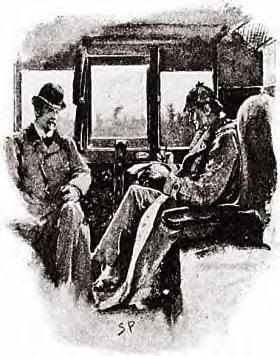
- “The Boscombe Valley Mystery”—Illustrator Sidney Paget, inspired by the mention of Holmes’s “close-fitting cap,” draws the detective in a deerstalker and creates an iconic image. Inspector Lestrade makes his second appearance. Oh, and a man’s been battered to death.
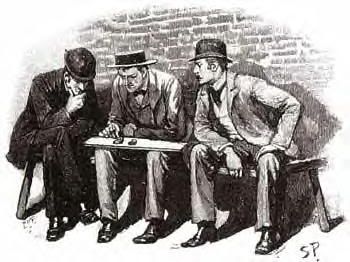
- “The Man with the Twisted Lip”—Dope fiends and Lascars and beggars, oh my! While rescuing a friend from a wharfside opium den, Watson encounters Holmes, who is investigating the fate of a vanished husband and father last seen at an upper window of that very building.
- “The Adventure of the Blue Carbuncle”—A Yuletide story about a battered hat, a gaggle of geese, and a stolen jewel.
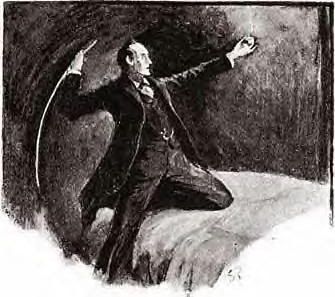
- “The Adventure of the Speckled Band”—This story opens with the (in)famous moment in which Holmes apologizes to Watson for “knocking him up” (i.e. waking him), and climaxes with an incredibly Freudian scene involving a ventilator shaft, a bell-rope, and a cane-wielding Holmes.
- “The Adventure of the Copper Beeches”—Miss Violet Hunter makes a favorable impression on the detective when she seeks his advice concerning the odd household that wishes to hire her as a governess, but, says Watson, “my friend Holmes, rather to my disappointment, manifested no further interest in her when once she had ceased to be the centre of one of his problems.”
The Memoirs…
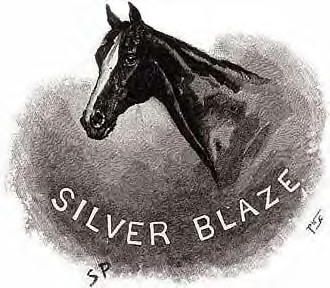
- “The Adventure of Silver Blaze”—This inquiry into the disappearance of a racehorse and the death of his trainer features “the curious incident of the dog in the nighttime.”
- “The Adventure of the Musgrave Ritual”—A reminiscence of the sleuth’s pre-Watson career, in which a college friend asks Holmes to investigate the disappearances of his butler and second housemaid, and their connection to the mysterious rite of the title.
Interesting Trivia: Some of the killers’ dialogue in T. S. Eliot’s play Murder in the Cathedral is a paraphrase of the ritual. - “The Adventure of the Greek Interpreter” (GREE)—Holmes introduces Watson to Mycroft, who asks his sibling to look into the strange story told by the title character, a fellow member of the Diogenes Club.
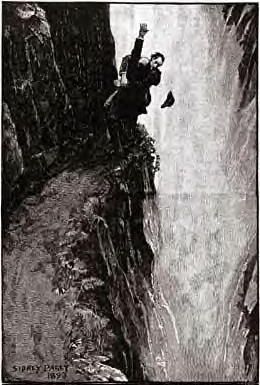
- “The Final Problem” (FINA)—“It is with a heavy heart” that Watson writes of the confrontation between Holmes and his nemesis, Professor Moriarty, which ends with the disappearance of the detective and the evildoer at the Reichenbach Falls in Switzerland.
THE GREAT HIATUS
The three-year period between “The Final Problem” and “The Adventure of the Empty House.” In the latter story Holmes gives Watson a synopsis of his movements during this time:
I took to my heels, did ten miles over the mountains in the darkness, and a week later I found myself in Florence, with the certainty that no one in the world knew what had become of me…. I travelled for two years in Tibet…and amused myself by visiting Lhassa, and spending some days with the head lama…. I then passed through Persia, looked in at Mecca, and paid a short but interesting visit to the Khalifa at Khartoum, the results of which I have communicated to the Foreign Office. Returning to France, I spent some months in a research into the coal-tar derivatives, which I conducted in a laboratory at Montpellier, in the south of France.
The Hound of the Baskervilles (HOUN)
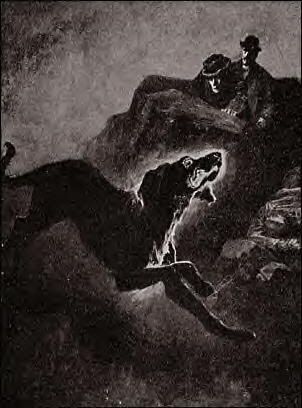
Are the deaths around a Devonshire estate the work of a spectral hound fulfilling an ancient curse, or is there a more material agent at work? The cast includes a country doctor who wants to finger Holmes’s parietal fissure, a secretive butler married to a doleful housekeeper, a butterfly-chasing naturalist, a litigious amateur astronomer and his disowned divorcée daughter, and a murderer recently escaped from the local prison. The best known and most frequently filmed story of the Canon, even though Holmes spends much of the book offstage while Watson accompanies the Baskerville heir to the wilds of Dartmoor, this novel was written after “The Final Problem” but set before it, so officially Holmes was still dead.
The Return…
- “The Adventure of the Empty House” (EMPT)—Three years after the Reichenbach Falls Holmes appears in Watson’s office, whereupon the doctor faints. Then it’s off to Camden House, the vacant building facing 221B, to lay in wait for an assassin.
- “The Adventure of the Dancing Men”— Holmes is asked to discover why his client’s young American wife is terrified by the chalk drawings that have been appearing around the grounds of their home.
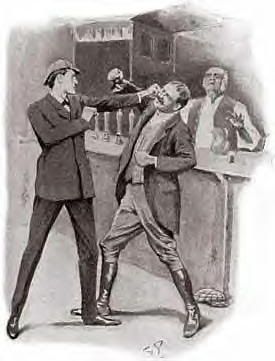
- “The Adventure of the Solitary Cyclist”—Holmes helps a “tall, graceful, and queenly” music teacher fend off various pursuers and displays his boxing prowess after being backhanded in a pub: “The next few minutes were delicious. It was a straight left against a slogging ruffian.”
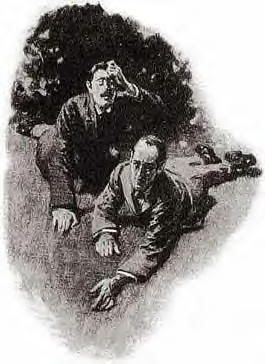
- “The Adventure of the Priory School”—Thorneycroft Huxtable, M.A., Ph.D., etc., the principal of the titular school, makes one of the Canon’s most dramatic entrances by fainting onto Holmes and Watson’s hearthrug before he asks them to solve the abduction of one of his pupils.
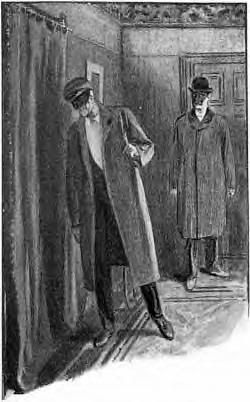
- “The Adventure of Charles August Milverton” (CHAS)—While familiarizing himself with the house of the title character, a blackmailer, Holmes, disguised as a plumber, gets engaged to a maid. This is the only evidence that Holmes ever got as far as first base. Later, during a spot of housebreaking, the doctor feels “a glow of admiration” as he watches his friend crack Milverton’s safe.
- “The Adventure of the Six Napoleons”—Who has been smashing plasters busts of Bonaparte throughout the city, and why? Holmes’s presentation of the answer causes Watson and Lestrade to spontaneously burst into applause.
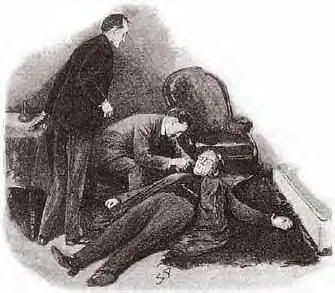
- “The Adventure of the Abbey Grange”—After waking Watson with the cry, “Come, Watson, come!… The game is afoot. Not a word! Into your clothes and come!” Holmes whisks him to the titular estate in Kent, then back to Baker Street, where as “a British jury, and I never met a man who was more eminently fitted to represent one,” the doctor decides the fate of a killer.

The Valley of Fear (VALL)
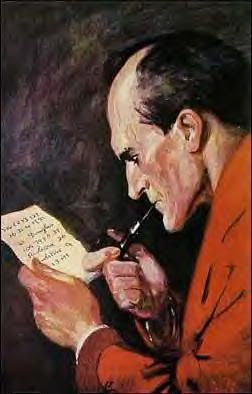
The fourth and final Sherlock Holmes novel bears a striking resemblance to the first. Like A Study in Scarlet, the book is divided into two parts. The first follows Holmes as he investigates a death—this time of a man found in moated Birlstone Manor House, his face destroyed by a double blast from a sawed-off shotgun. The second informs the reader of earlier events in Vermissa Valley, Pennsylvania, U.S.A., where jealousy and conspiracy spawn a decades-long vendetta. Finally, there is an epilogue in which we learn the ultimate fates of the principals in the case. However, there is one great difference between this story and its predecessor: the involvement of Professor Moriarty. It is an informant in Moriarty’s network who sends Holmes a ciphered message warning of the threat at Birlstone, and it is clearly the Professor who anonymously penned the mocking note which reads, “Dear me, Mr. Holmes! Dear me!” that the detective receives at the story’s conclusion.
Interesting Trivia: The American portions of The Valley of Fear were inspired by Allan J. Pinkerton’s The Molly Maguires and the Detectives. Pinkerton’s book is a fictionalized account of the campaign that members of his private detective agency conducted against a secret society of Pennsylvania coal miners, who were either a ruthless gang of thugs or exploited men trying to protect themselves from the minions of rapacious industrialists, depending on which historians you believe.
His Last Bow
- “The Adventure of a Cardboard Box”—After applying the mind-reading techniques of Edgar Allan Poe’s sleuth, C. Auguste Dupin, to Watson, Holmes endeavors to discover why someone would mail two human ears to an inoffensive spinster.
Interesting Trivia: This story of obsession and adultery originally appeared in the Strand magazine as part of the series later published in The Memoirs..., but Conan Doyle, apparently motivated by concern over the story’s themes, held it back from republication until His Last Bow. - “The Adventure of the Bruce-Partington Plans” (BRUC)—In an attempt to recover stolen plans and solve the murder of a government clerk, Holmes and Watson conduct their second foray into burglary.
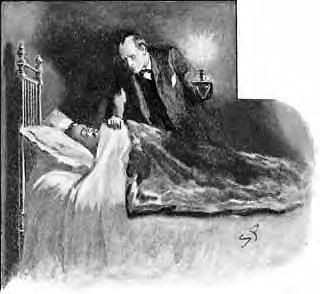
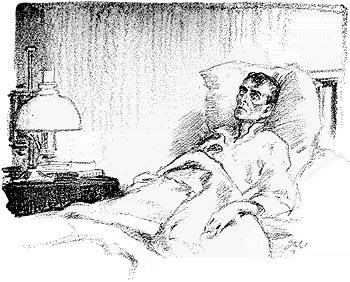
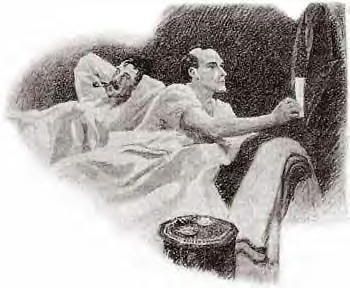
- “The Adventure of the Dying Detective” (DYIN)—Set during the second year of Watson’s marriage, the doctor is summoned to Baker Street by a worried Mrs. Hudson and finds Holmes babbling about half-crowns and oysters. Later the detective asks Watson to hide behind his bed, pleading, “Quick, man, if you love me!”
- “The Adventure of the Devil’s Foot”—While holidaying in Cornwall, Holmes investigates an outbreak of insanity and death among three brothers and their sister. After he nearly kills himself and Watson testing a theory, Holmes apologizes to the doctor, who replies, “with some emotion, for I had never seen so much of Holmes’s heart before, ‘…[I]t is my greatest joy and privilege to help you.’”
- “His Last Bow”—Subtitled “An Epilogue of Sherlock Holmes” and chronologically the final story, this is an account of Holmes’s dealings with a German spy on the eve of World War I.
The Case-Book…
- “The Adventure of the Illustrious Client”—After a peek at Holmes and Watson in a Turkish bath, we follow their efforts to prevent the marriage of Violet de Merville, a young English noblewoman, to Baron Grunier, an Austrian “aristocrat of crime” who arranges for a “murderous attack” upon Holmes.
- “The Adventure of the Sussex Vampire”—Yes, one could argue that there’s a Canonical basis for vampire!fic, even though the sleuth gripes, “What have we to do with walking corpses who can only be held in their grave by stakes driven through their hearts?… This agency stands flat-footed upon the ground, and there it must remain. The world is big enough for us. No ghosts need apply.”
- “The Adventure of the Three Garridebs”—Here’s Watson description of Holmes after the doctor is grazed by a bullet: “It was worth a wound…to know the depth of loyalty and love which lay behind that cold mask. The clear, hard eyes were dimmed for a moment, and the firm lips were shaking. For the one and only time I caught a glimpse of a great heart as well as of a great brain. All my years of humble but single-minded service culminated in that moment of revelation.”
- “The Problem of Thor Bridge”—In this story, which features a strikingly clever and vindictive killer, Watson mentions the “travel-worn and battered tin dispatch-box” in the vaults of Cox and Co. Bank that contains records of various unpublished cases. It must be gigantic (or a TARDIS), judging by the number of pastiches and fanfics it has allegedly disgorged.
Notable Adaptations
According to the Guinness World Records, “The character most frequently recurring on the screen is Sherlock Holmes…portrayed by some 75 actors in over 211 movies since 1900.” I will be discussing only a few of these performances. Those interested in learning more should visit the pages on Holmes in film and television at the Sherlock Holmes Society of London’s official Web site. There are also various books on the subject; I recommend David Stuart Davies’s Holmes of the Movies and Starring Sherlock Holmes, and The Films of Sherlock Holmes by Chris Steinbrunner and Norman Michaels.
The Rathbone–Bruce Films
In March 1939, Twentieth Century-Fox released The Hound of the Baskervilles, starring Basil Rathbone, a Shakespearean-trained actor best known for playing aristocratic villains, as Sherlock Holmes (though he’s billed second, after Richard Greene as Henry Baskerville) and Nigel Bruce as Dr. Watson (billed fourth). The studio made a point of announcing that this was the first Holmes film to present the sleuth in his proper Victorian milieu (unlike earlier movies, which had shown the detective using telephones and automobiles). The set for 221B is far too bare and grandiose, but the London streets are well realized, and the moor, an enormous soundstage swathed in picturesque billows of artificial fog, is spectacular. The script is largely faithful to Conan Doyle’s story, aside from streamlining in some places and expansion in others. The direction is competent, though occasionally the pace lags, and while no attempt is made to give the hound a supernatural appearance its climactic pursuit and attack are genuinely nerve-wracking. I must comment on the final scene, which is jarring: after a grateful character says, “God bless you, Mr. Holmes,” the detective thanks him and announces he is going to bed, only to call from the room’s threshold, “Oh, Watson, the needle.” Excuse me while pick my jaw off the floor.
Encouraged by the enthusiastic response to The Hound, the studio pursued hopes of a lucrative series by filming The Adventures of Sherlock Holmes later that year. The opening credits claim it is based on William Gillette’s play Sherlock Holmes, which is a thumping lie: aside from the characters of Holmes, Watson, Billy the page boy, Moriarty, and Moriarty’s henchman Bassick, the movie takes nothing from the stage melodrama. This second film has better direction but a weaker script: two key characters’ motives are left unclear, and the plot—in which Moriarty uses a bizarre murder to distract Holmes from his attempt to steal the crown jewels from the Tower of London—is full of holes. (Among other absurdities, the heroine attends a garden party in a frilly, light-colored frock two days after her brother’s death, when etiquette would have required her to withdraw from society and wear full mourning for three months. However, her actions give Holmes the opportunity to disguise himself as a Cockney song-and-dance man, a moment not to be missed.) The Conan Doyle estate was dissatisfied with The Adventures and asked that all future productions be adaptations from the Canon. When Twentieth Century-Fox balked at this requirement, they lost the chance to make more Holmes films.
Three years passed, during which Rathbone and Bruce started playing Holmes and Watson in radio dramas, before a new series of films began under the aegis of Universal Pictures. From 1942 to 1946 the studio released twelve movies: Sherlock Holmes and the Voice of Terror (September ’42), SH and the Secret Weapon (January ’43), SH in Washington (April ’43), SH Faces Death (September ’43), The Spider Woman (January ’44), The Scarlet Claw (June ’44), The Pearl of Death (August ’44), The House of Fear (March ’45), The Woman in Green (June ’45), Pursuit to Algiers (October ’45), Terror by Night (February ’46), and Dressed to Kill (May ’46). Several of the films are credited as adaptations of specific tales (which in practice means only the use of a distinctive character or a plot device from the Canon), while others are merely based on “a story” or “characters created” by Sir Arthur Conan Doyle. Unlike the Twentieth Century-Fox films, they are set in the 1940s (though oddly enough, the new 221B set is far more convincing than its predecessor). The first three are spy thrillers that pit Holmes and Watson against agents of the Third Reich, while the remainder are murder mysteries. The quality of the scripts varies, but director Roy William Neill—who helmed all but the first of the Universal movies—does an excellent job, and the acting is consistently good.
This brings us to the question of Rathbone’s and Bruce’s performances. Between the films and the radio shows, it’s no wonder that they are the actors most closely associated with Holmes and Watson to this day. This was both good and bad for the fandom: good, because they kept the characters in the public eye; bad, because theirs is a distorted version of the Canonical relationship between the detective and his chronicler. Now, Basil Rathbone is wonderful: with his height, lean figure, high forehead, and strong profile, he bears a striking resemblance to the Paget illustrations. He delivers his dialogue briskly, has a lot of fun with the disguises, and is convincingly ruminative, arrogant, sardonic, and masterful. One reviewer described his performance as “making the character credible rather than eccentric,” which strikes me as a fair verdict. His co-star, Nigel Bruce, is convincing and endearing as Watson; the problem is that the writers made him the comic relief, so Bruce is often playing an idiot. This is most observable in the Universal series, but it has its roots in the Twentieth Century-Fox films. In his commentary for MPI’s DVD release of The Hound, David Stuart Davies, editor of Sherlock Magazine, makes an interesting observation: Watson is competent and sensible on his own, but around Holmes he bumbles and blusters as though overawed. I think their dynamic is best illustrated by a scene from The Adventures, in which the detective tells Watson, “I’m afraid you’re an incorrigible bungler,” and the downcast doctor murmurs, “Afraid I am.” Holmes then pats his friend on the shoulder, and Watson immediately perks up and smiles. Overall the impression is of a man who is loyal and brave, but rather dim.
Following Dressed to Kill, Rathbone announced that he would no longer play Holmes in films or on the radio. He’d begun to find the detective unpleasant, especially in his condescending treatment of Watson, and feared he’d become, as he phrased it in his autobiography In and Out of Character, “more completely ‘typed’ than any other classic actor has been or ever will be again.” Despite his resolution he did don the deerstalker a couple more times, most notably in an unsuccessful stage play written by his wife, Ouida, and the role haunted him until his death in 1967.
The Granada Television Series
Of all the actors who have played Sherlock Holmes in the past sixty years, only one is a serious threat to Basil Rathbone’s supremacy: Jeremy Brett. He starred in six series—two titled The Adventures (April–June 1984 and August–September 1985, 13 episodes total), two titled The Return (July–August 1986 and April 1988, 11 episodes) The Casebook (February–March 1991, 6 episodes), and The Memoirs (March–April 1994, 6 episodes)—and five feature-length episodes—The Sign of Four (December 1987), The Hound of the Baskervilles (August 1988), The Master Blackmailer (January 1992), The Last Vampyre (January 1993) and The Eligible Bachelor (February 1993)—produced by British company Granada Television.
Born Peter Jeremy William Huggins (he picked his alias off a suit label after his father asked him not to pursue a theatrical career under the family name), Brett had a knack for upper-class figures with romantic and/or sinister tendencies. His previous roles included Dorian Gray, Dracula (in a stage production designed by Edward Gorey), and Freddie Eynsford-Hill in the movie musical My Fair Lady. In interviews he sometimes claimed that he felt horribly miscast as Holmes, but this seems to have made him all the more determined to delve into the detective’s psyche. He augmented close readings of Conan Doyle by imagining a childhood and adolescence for Holmes that included many autobiographical elements. The result is a hugely idiosyncratic performance that nonetheless hews to the Canon. Brett’s eccentric investigator is arguably both the strangest and most human version of the character yet seen. This Holmes is brilliant, energetic, charismatic, and funny; he’s also overbearing, untidy, and frequently bad tempered. He literally lunges at clues, and heaven help the recalcitrant witness or resentful Scotland Yarder who stands in his way. When disguised he’s often unrecognizable until he reveals himself. Above all, he’s mercurial: whether he’s questioning a client, crawling over a carpet, or swaying with closed eyes at a recital, it’s nearly impossible to look away, in large part because you can never be sure what he’s going to do next. The fact that in The Adventures, The Return, and The Sign of Four he’s very easy on the eyes doesn’t hurt. And oh, don’t get me started on the voice.
As good as he is, Brett’s performance would not have been so effective if he hadn’t had a great Watson to play against. Fortunately, he got lucky twice. In The Adventures the character is portrayed by David Burke, who depicts Watson as bright, bluff, and blessed with a backbone. When Burke left the role to spend more time with his family, he suggested Edward Hardwicke as his successor. The proposal proved a sound one, and Hardwicke played the doctor in all the other Granada adaptations. His Watson is quieter and mellower than Burke’s, but he’s just as wry, sensible, and sympathetic. Brett has a wonderful rapport with both actors, and throughout the Granada series Holmes’s affection for his friend and amanuensis is both obvious and inarguable—Watson possesses an appetite for adventure, moral sense, compassion, and above all, faithfulness, that make him the ideal partner and confidante for the detective.
Unfortunately, the quality and high level of Canonical fidelity that characterize the first four series and The Sign of Four could not be sustained through the later productions. This was partly due to changes in the executive staff at Granada: as new people replaced the series’ creators, the determination to be absolutely faithful to Conan Doyle’s stories waned. Another issue was the dwindling supply of source material—the best stories had already been done, and the remainder required more rewriting to be interesting television. This was especially true of The Last Vampyre and The Eligible Bachelor, which differ so greatly from the stories which inspired them (“The Sussex Vampire” and “The Noble Bachelor,” respectively) that they’re nearly unrecognizable. But the biggest problem was the string of crises that beset Jeremy Brett. First, his wife Joan Wilson, an American television executive, died of cancer in the summer of 1985. Later, during the filming of The Return, Brett was hospitalized for ten weeks after suffering a breakdown. During his recovery the actor, long known for eccentric and flamboyant behavior, was diagnosed as manic-depressive and prescribed lithium, which improved his psychological state but had unfortunate side effects: bloating from water retention, decreased energy, difficulty concentrating, and worst of all, the progressive deterioration of his heart. By the time he made The Memoirs, Brett’s health was so poor that he collapsed on set. He died on September 12, 1995, the year after his final performances as Sherlock Holmes were broadcast.
The Twenty-first Century
A clear successor to Brett has yet to emerge, but there have been attempts. As of 2004, Matt Frewer (Max Headroom) has starred in four Holmes TV movies, to mixed reviews. In 2002 Richard Roxburgh (Moulin Rouge!, The League of Extraordinary Gentlemen, Van Helsing) played the detective in a BBC production of The Hound of the Baskervilles, in which his Holmes had an unusually contentious relationship with Ian Hart’s Watson. Hart will reprise his role opposite another new Holmes, Rupert Everett, in a project titled The Return of Sherlock Holmes. They’ll be facing competition from longtime Sherlockian Stephen Fry, as Holmes, and Fry’s frequent co-star Hugh Laurie, as Watson, in a television special that may serve as a series pilot if its ratings are good. [Update: the Everett/Hart film, titled Sherlock Holmes and the Case of the Silk Stockings, aired in 2004 and was largely regarded as a disappointment despite Everett’s and Hart’s excellent performances. Sadly, nothing has come of the Fry/Laurie project, though as the protagonist of House M.D. Hugh Laurie is quite Sherlockian.]
December 2009 saw the release of Sherlock Holmes, directed by Guy Ritchie and starring Robert Downey, Jr., as Holmes, Jude Law as Watson, and Rachel McAdams as Irene Adler. Downey’s Holmes is a raffish, Bohemian genius whose fists are as fast as his mind, while Law portrays the most competent and complicated Watson yet. The film, which pits our heroes against a murderous occultist, both follows and disregards Canon—for example, Watson’s fiancée is clearly identified as Mary Morstan, yet the events of The Sign of Four have not occurred, for she is a stranger to Holmes with living relations. Overall, this adaptation is more respectful towards the source material than not, and probably won’t offend any fan who doesn’t object to martial arts, magical rituals, and explosions on principle.
The Pairings
Holmes/Irene Adler
There is widespread belief in a Holmes/Adler romance—often claimed to have resulted in a son—despite seemingly insurmountable obstacles. First, Watson specifies that Holmes felt “no emotion akin to love” for the lady. Second, Holmes witnesses Adler’s marriage to Godfrey Norton, a barrister. Finally, Watson’s description of Adler as being “of dubious and questionable memory” implies that she died sometime before he penned “A Scandal in Bohemia.” Most Holmes/Adler ’shippers blithely disregard the first statement and declare the third an error, while the inconvenient Norton is dismissed as a corpse or a cad when he’s acknowledged at all. (An exception is Carole Nelson Douglas’s Irene Adler Adventuress series, in which a crime-solving Adler’s happy marriage to Norton still allows gobs of UST with Holmes.)
Watson/Mary Morstan
Aside from their courtship in The Sign of Four we aren’t told much about Watson’s marriage to Mary. She is presented as supportive of her husband’s continued participation in Holmes’s cases, and likely felt some fondness and gratitude toward the detective for introducing her to Watson, not to mention solving the mystery of her father’s disappearance. On the other hand, some Sherlockians have suggested that she saw Holmes as a rival for her spouse’s attention. However, as Watson reports that “after my marriage…these occasions grew more and more seldom, until I find that in the year 1890 there were only three cases of which I retain any record” (FINA), it would appear that he made his domestic and professional obligations his highest priorities.
Mary’s presumed death during the Great Hiatus is sometimes ascribed to complications arising from a miscarriage, because God forbid the fans miss an opportunity to pile on the angst.
Holmes/Various OFCs
Although Holmes’s usual love interest is the Woman, he has been linked with others. The earliest example was in William Gillette’s stage melodrama Sherlock Holmes, which ended with the detective engaged to the insipid ingenue, Alice Faulkner. However, it occurs most frequently in films: during Billy Wilder’s 1971 film The Private Life of Sherlock Holmes, the sleuth softens toward his client; the end of The Seven-Per-Cent Solution (1976) implies a dalliance with the distressed damsel; and the wildly AU Young Sherlock Holmes (1985, script by Chris Columbus, directed by Barry Levinson, with Stephen Spielberg as executive producer; no, really) claims that Holmes chose to remain true to the memory of a mentor’s daughter. Most recently, Laurie R. King’s popular Sherlock Holmes/Mary Russell books have paired the detective with a brilliant, strong-willed, Jewish-American woman who progresses from adolescent protégée to wife and full-fledged colleague.
Watson/Various OFCs
“The fair sex is your department,” Holmes says to Watson in “The Adventure of the Second Stain.” While Holmes is more frequently the object of authors’ attempts at matchmaking (probably because he’s more of a challenge), Watson gets his turn on occasion—after all, there is at least one other Mrs. Watson to be accounted for. Interestingly, one of the best-known of Watson’s uncanonical romances ends unhappily: in the play The Crucifer of Blood, which is loosely based on The Sign of Four, Watson falls for the female lead, only to discover that she is a villain.
Holmes/Watson
This is the major slash pairing for this fandom, and the fanfic comes in all flavors: first-time, longtime, happy, tragic, angry, unrequited, denied, guilty, hurt/comfort, and kinky (between Holmes’s gift for dress-up and Watson’s doctor’s-bag, imagine the possibilities!).
While the idea of a romantic or sexual relationship between the detective and his chronicler remains controversial—there’s a reason Miss Roylott named her Holmes slash archive Sacrilege!—it has been discussed in mainstream fandom. Billy Wilder raised the possibility in The Private Life of Sherlock Holmes with a scene in which Holmes fends off a Russian ballerina by claiming that Watson is his lover.* Although this was clearly a joke, many Sherlockians bristled. One member of the Sherlock Holmes Society of London stated, “We’d played around with the idea, twisting quotations and taking them out of context, but that was only for our own amusement. We’d never do it in public.”
Despite this don’t-scare-the-horses policy, I know of two commercially available books that send Holmes and Watson down Queer Street. Larry Townsend’s The Sexual Adventures of Sherlock Holmes is a collection of pornographic parodies, while My Dearest Holmes, by Rohase Piercy, is an excellent two-part pastiche which shows how Holmes and Watson’s relationship changes shortly before Watson’s marriage and immediately prior to and after the Great Hiatus.
Update: As of 2009, the topic was still a contentious one for some. After Robert Downey, Jr., speculated about Holmes’s sexual orientation and the nature of his relationship with Watson on The Late Show with David Letterman, there were news articles stating that the Conan Doyle literary estate was threatening to block any sequel to Sherlock Holmes. These reports were based on remarks attributed to Andrea Plunket, who claims to hold the remaining U.S. copyrights for the Holmes stories: “It would be drastic, but I would withdraw permission for more films to be made if they feel that is a theme they wish to bring out in the future. I am not hostile to homosexuals, but I am to anyone who is not true to the spirit of the books.” However, Ms. Plunket later denied making such a statement, and told the New York Times Arts Beat blog that she loved the film and considered it truer to Canon other cinematic adaptations. (In any case, according to Sherlockian.net, Ms. Plunket’s claims to rights in the stories have been denied by U.S. federal courts, and her attempt to trademark the name “Sherlock Holmes” was also rejected.)
*Interesting Trivia: Holmes’s predicament was inspired by an anecdote about George Bernard Shaw, in which Isadora Duncan sent him a letter declaring that they should have a child together—“With my body and your brains, what a wonder it would be.” Shaw allegedly replied, “But what if it had my body and your brains?”
Holmes/Moriarty
(Because only two people who have Done It can hate each other that much.)
It is noteworthy that Holmes’s and Moriarty’s mutual loathing does not prevent them from paying each other what appear to be sincere compliments. Holmes confesses, “My horror at [Moriarty’s] crimes was lost in my admiration at his skill,” while Moriarty tells Holmes, “It has been an intellectual treat to me to see the way in which you have grappled with this affair, and I say, unaffectedly, that it would be a grief to me to be forced to take any extreme measure.” Some Sherlockians have suggested that Holmes knew Moriarty before the professor turned criminal, or before Holmes became aware of Moriarty’s extracurricular pursuits; the professor may have tutored Holmes as a child, or encountered the future sleuth as a adolescent.
Watson/Murray
According to Watson, after he was wounded at Maiwand, “I should have fallen into the hands of the murderous Ghazis had it not been for the devotion and courage shown by Murray, my orderly, who threw me across a pack-horse, and succeeded in bringing me safely to the British lines” (STUD). Various speculations have been made concerning their relationship during Watson’s military service, and it has been suggested that they kept in touch following the doctor’s return to London.
The Fandom On-line
The Canon
Camden House—all sixty of the Canonical stories, plus illustrations and other graphics, sound clips, wallpapers, and screensavers.
221B Baker Street—another site with all the stories, illustrations, and sound clips.
Livejournal Communities
Sherlock Holmes’ Journal—for fans of the Canon.
Cox & Co—a Sherlock Holmes slash community.
Fan Sites
The Sherlock Holmes Society of London
The Sherlockian.net Holmepage [sic]—An incredibly comprehensive site maintained by Sherlockian Christopher Redmond.
Sherlock Holmes International—A Sherlockian resource site which can be viewed in French, English, Dutch, Spanish, Italian, Danish, or Japanese.
Slash-Friendly Sites
Sacrilege!—a slash-oriented site with a fiction archive, articles, and a links page.
Slash Cotillion: The Historical Slash Archive—For stories set prior to the 1960s.
Acknowledgments
I must give thanks to the habitues of cox_and_co and the Holmesslash group at Yahoo, who critiqued portions of this overview when it was a work in progress.
Many thanks also to Karen Shepherd, who kindly sent me dozens of screencaps from the Granada Television series; go check out her very handsome Tribute to Jeremy Brett.
no subject
This is a really comprehensive, informative, fun essay, and it totally rocks. It may not be complete, but it's still good! ...and now I'll be skulking in the shadows until it's done, you realise.
no subject
And there is Holmes/Moriarty slash? Oh my God, yes... Why have I never seen that before? Where can I find it?
no subject
Similarly, two works by William S. Baring-Gould examine Sherlock Holmes and Stout's detective Nero Wolfe, suggesting they are linked by blood. Both books are very entertaining.
No time to say more, I'm afraid -
no subject
no subject
no subject
no subject
I was plugging away last night when I realized, I have the profiles, the pairings, and most of the story summaries done; I’d better post this bad boy before some freakish accident destroys my computer and the backup disk.
Re: No time to say more, I'm afraid -
no subject
no subject
Also, Holmepage is the worst pun I've seen in ages. Ahah. *g*
OMG! Thank You!
It drove me insane when I read "Scandal." I knew I'd seen the name Irene Adler before, but I just couldn't place it.
Do you know if Destiny was actually supposed to be THAT Irene Adler, or was it just a play on words by Claremont?
no subject
Re: OMG! Thank You!
no subject
Do you have any recs?
If I'd had any idea what I was getting into...
So, thank you for giving me this opportunity!
no subject
no subject
Also: "spending a lot of time on his knees" indeed. *snerk* Ah, how I love bad jokes. And dude, if Mrs Hudson was Scottish then Holmes wouldn't have said "as", but never mind, eh? :)
no subject
I’ve never bought the Mrs.-Hudson-as-Scot argument either, but it’s a popular idea so I thought I should mention it.
And I couldn’t resist the knees comment, especially since it’s right there in the story.
no subject
no subject
no subject
no subject
no subject
no subject
no subject
Ah, Jeremy...I just rewatched “The Dancing Men,” and I’d forgotten about the moment when he does a little jumping jack to show Watson which symbol stands for E. Aiiiieeeeeeee, ilovehimsomuch!
no subject
no subject
Thank you for writing such a splendid essay- it really showcases why people would interested in Sherlock Holmes. Before comic books became popular, this was the thing!
no subject
no subject
no subject
no subject
No mention of Peter Cushing, though? His Hound of the Baskervilles may have been a Hammer film, but it was still great.
no subject
In my first draft the section on movies was longer and did mention Peter Cushing, but I ran up against the word limit. Also, while I'll bet Cushing was a superb Holmes (I haven't seen his Hound) he isn't identified with the role the way Rathbone and Brett are, so I chose to focus on the big two.
no subject
no subject
Feel free!